
- The number of people seeking rooms to rent in London has dropped by almost a fifth since 2020, but where are they going?
- Well-connected locations in three Home Counties in particular - Hertfordshire, Essex and Surrey - have seen significant increases in flatsharer interest.
- Essex market town Waltham Abbey, an hour's commute from central London, has seen the highest increase in interest (+113%) among flatsharers.
Steep increases followed by years of stubbornly high rents in London appear to have taken the shine off flatsharing in the capital, according to data from flatshare site SpareRoom.
The number of people looking for rooms to rent in London fell by almost a fifth (-18%) as those seeking rooms across the rest of the UK increased by 11%, comparing Jan 2026 to Jan 2020, before the pandemic.
SpareRoom also analysed more than 241 million area search terms input by those landing on its site in 2025 compared to the previous year. Searches for 'London' fell 14% and searches for London postcode areas also fell between a fifth and a third. Interestingly, searches for 'Greater London' increased by 38%, as interest rises in outer parts of the capital where rents are more affordable.
| Area search term input by SpareRoom users | % change |
|---|---|
| East Central London | -31% |
| East London | -22% |
| Greater London | +38.2% |
| London | -14.2% |
| North London | -20.4% |
| North West London | -29.9% |
| South East London | -24.7% |
| South West London | -28.9% |
| West Central London | -34.7% |
| West London | -21.2% |
The area with the highest increase (+113%) in renter interest in the country is Waltham Abbey, an Essex market town where the average room rent is now £784 per month*, much lower than inner London (£978 per month) and within commuting distance.
Parts of outer London, where rents are also lower than inner London - on average £811 per month - are seeing notable increases in searches by flatsharers. These include the westernmost London borough Hillingdon (+62%), northwest London suburb Sudbury (+60%), north London town Enfield (46%), west London suburb Ruislip (+40%) and Hounslow suburb Heston (+39%).
Beyond outer London, three Home Counties in particular are increasing in popularity among flatsharers. Rising Hertfordshire hotspots for housesharing include Baldock (+62%) and Broxborne (+60%), both connected by fast trains to London. Elstree (+36%), Borehamwood (+32%) and Radlett (+31%) - all well connected to central London by Thameslink - have all seen searches increase by around a third. Searches for Kings Langley (+28%) and central St Albans (+26%), which has one of the best commuter links north of London, are rising too.
Essex is also a popular choice for flatsharers looking to migrate further out. High risers capturing attention behind Waltham Abbey (+113%) include Buckhurst Hill (+47%), and Chigwell (+30%), which are both on the Central line, Southend-on-sea (+42%), South Ockendon (+36%), market town Rayleigh (+30%) and Gidea Park (+29%) on the Elizabeth line.
In Surrey, it's Walton-on-Thames (+50%), just 25-minutes from Waterloo, Reigate (+47%), Banstead (+45%), Virginia Water (+43%) and Guildford GU1 (+33%) and GU2 (+27%), that have seen the highest annual increases in flatsharer searches.
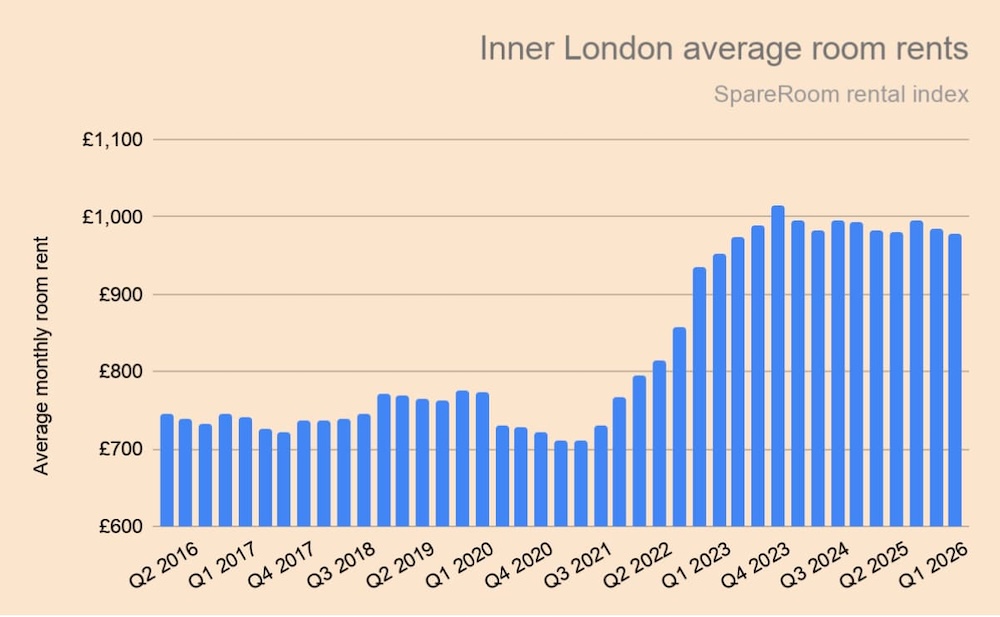
The average room rent in inner London is now £978 per month based on data from the first quarter of 2026, 27% higher than Q1 2020 (£773), before the pandemic caused chaos in the rental market. The table below shows the trajectory of inner London room rents since 2016, which were grossly inflated by fierce demand post-pandemic:
Matt Hutchinson, director of flatshare site SpareRoom, comments: “Area searches give us a sense of where the market is headed and, in this case, it's out of inner London and into commuter territory. Even for those who are happy to share with housemates, it may be just too expensive to live in the capital today after years of rent rises. And it's not only rent, it's the higher cost of living to contend with too. Remote working offers the possibility of moving further out without the expense and hassle of a daily commute.
“You also have to consider the demographics of flatsharers today. Younger people are increasingly priced out of the rental market, and people are flatsharing to later in life. The stereotype of the young professional housemates living it up in the city is becoming less recognisable. Priorities are changing.”